
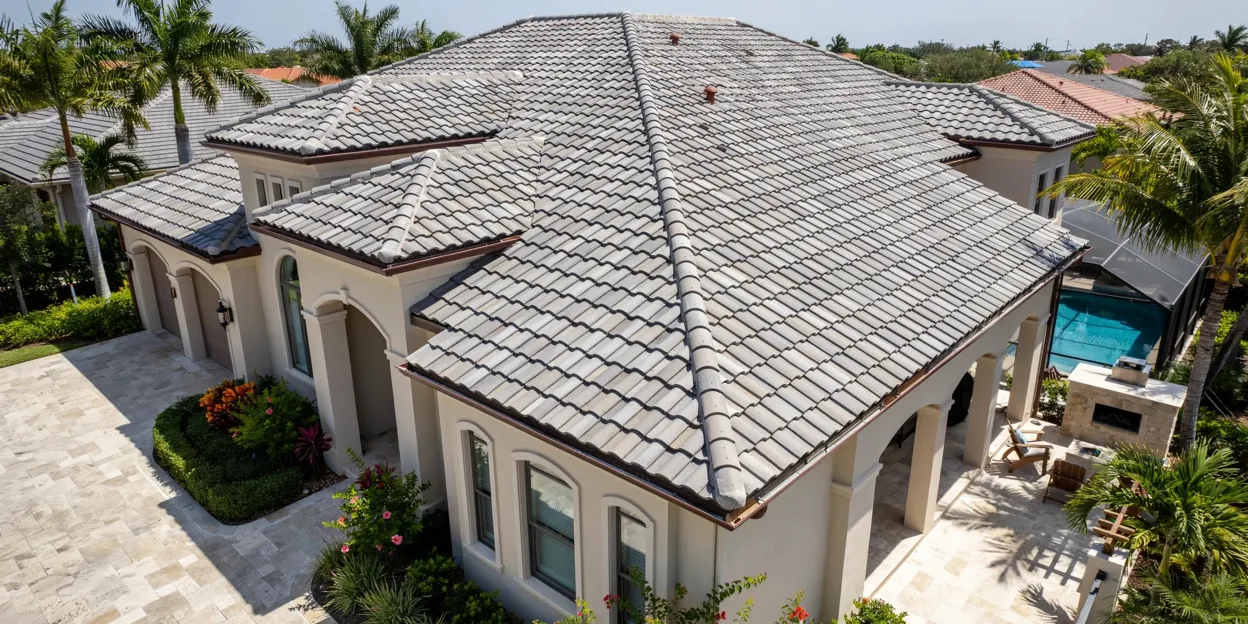
The renewal quote came in higher than last year, the agent asked whether the house has ever had a wind-mitigation inspection, and you are not sure what that is. The roof went on in 2006 with the house. This site connects you by phone with an independent local roofing contractor who handles wind mitigation in St. Johns County.
The inspection follows the state's uniform form, line by line. Roof covering and the year it was permitted. Deck attachment, which means the nail size and spacing holding the plywood to the trusses, read from the attic. Roof-to-wall connection: toe nails, clips, single wraps, or double wraps. Roof shape, because a hip roof gets more credit than a gable. Secondary water resistance, which is the self-adhered membrane under the covering. And opening protection, meaning shutters or impact glass.
Each answer is photographed, because the carrier credits the photo, not the word. The finished form goes to your agent.
Find the last wind-mitigation form the house was insured with, if there was one; it lists what was credited before. Find the roof permit year. Clear a path to the attic hatch, because the deck-nailing and connection lines cannot be answered from the ground. If a roof replacement is coming, hold the inspection until after, since the new roof changes most of the lines.
Most houses built or re-roofed in St. Johns County since the 2002 code already have the credit-earning features by construction: ring-shank or 8d nails at the current spacing, a self-adhered underlayment, and clips or straps at the wall. The subdivisions from World Golf Village through Nocatee are full of roofs that qualify and have never been documented. A single inspection converts that into a credit on the wind portion of the premium at the next renewal.
Older roofs earn credits in stages. Secondary water resistance and deck re-nailing are done during a replacement, when the deck is open. A retrofit of the roof-to-wall connection is possible between replacements on some houses. The roof inspection page covers the condition report a carrier may ask for alongside the form.
The Florida Office of Insurance Regulation publishes the OIR-B1-1802 form, and Florida law requires carriers to credit the documented features on it. The credits are not automatic. No form, no credit, and a new roof on a house in Julington Creek is still being rated as the old one until the form is filed.
The coast from Ponte Vedra to Crescent Beach is a wind-borne debris region under the Florida Building Code, and the wind portion of a premium runs heavier there than in Fruit Cove or Hastings, which is why an island or Vilano homeowner sees the biggest change from a documented roof. Inside the City of St. Augustine's historic districts, opening protection and roof-to-wall retrofits on a contributing house go through the review board like any other visible change, and the historic district roofing page explains that step.
What mitigation is not: a promise against every storm. It is better odds, in writing, and a lower number on the wind line of the premium.
Have the address, the roof material and permit year, whether the house has had a form before, and whether a renewal deadline is driving the call. Say whether the attic is accessible. Call (904) 895-7548.
 Standing by
Describe the roof in plain words. The call is routed to an independent local roofing contractor who works shingle, metal, and tile roofs in your part of St. Johns County.
Roof work inside the city's HP zoning districts, where a Certificate of Appropriateness from the review board comes before the permit.
What to photograph, what a written roofing scope gives your adjuster, and how Florida's claim deadlines and roof-age rules work after a storm.
A lifted shingle after a nor'easter, a rusted fastener line on island metal, or a flashing seam at a chimney, traced to the source and fixed in writing.